
Key Takeaways
- Advanced imaging tools like X-ray, ultrasound, and CT scans allow veterinarians to see beyond what a physical exam can reveal.
- Early detection of conditions like tumors, internal injuries, or organ issues dramatically improves treatment outcomes.
- Allied Veterinary Emergency and Referral provides state-of-the-art diagnostic imaging on an emergency basis at our Brooklyn Park and Eden Prairie locations.
- Our team is invested in providing clear answers and compassionate care when your pet needs it most.
The Unseen Advantage: Why a Physical Exam Isn’t Always Enough
As a pet owner, you know your companion better than anyone. You notice the subtle shifts in their energy, appetite, and behavior. When something feels off, your first step is often a visit to the veterinarian for a thorough physical exam. These hands-on assessments are the cornerstone of veterinary medicine—allowing us to check your pet’s heart, lungs, temperature, and physical condition. But what happens when the problem isn’t on the surface?
Many serious health conditions, from tumors and foreign objects to organ dysfunction and internal injuries, develop silently. They hide from sight, often producing no clear outward symptoms until they have become advanced and more difficult to treat. This is where a physical exam reaches its limit and the true power of advanced diagnostic imaging for pets becomes indispensable.
Imaging technology gives our veterinary team a crucial advantage: the ability to see inside your pet’s body with incredible clarity and precision. It’s a non-invasive window that reveals the intricate workings of their internal systems, helping us find problems that our hands and eyes cannot. This commitment to going deeper is central to our philosophy. You can learn more about our invested approach, which drives us to use every tool available to ensure your pet receives the most comprehensive care possible. By seeing the unseen, we can move from suspicion to certainty, providing the clear answers you need and the effective treatment your pet deserves.
A Closer Look at Our Diagnostic Imaging Tools
When your pet is unwell, terms like “X-ray,” “ultrasound,” and “CT scan” can sound intimidating. At Allied Veterinary, we believe in demystifying the process, ensuring you feel confident and informed every step of the way. These technologies are simply different tools we use to get the best possible look at what’s happening inside your pet. Think of them as different types of cameras, each designed to capture a specific kind of image to solve a particular medical mystery. Understanding what each tool does can provide peace of mind and clarity during a stressful time. Our team is equipped with a full suite of our advanced diagnostic imaging services to ensure we can get a precise diagnosis quickly and efficiently.
Digital X-Rays: For Bones, Lungs, and Abdominal Views
Digital radiography, or X-ray, is one of the most common and effective imaging tools in veterinary medicine. It uses a small, safe amount of radiation to create detailed images of dense structures within the body. It’s the gold standard for evaluating bones, making it essential for diagnosing fractures, assessing joint health, and identifying bone abnormalities.
Beyond the skeleton, X-rays provide excellent views of the chest cavity, allowing our veterinarians to assess the heart’s size and shape, examine the lungs for signs of pneumonia or masses, and check for fluid accumulation. In the abdomen, X-rays can quickly identify swallowed foreign objects, detect signs of intestinal blockages, and locate certain types of bladder stones.
Ultrasound: For Real-Time Views of Soft Tissues and Organs
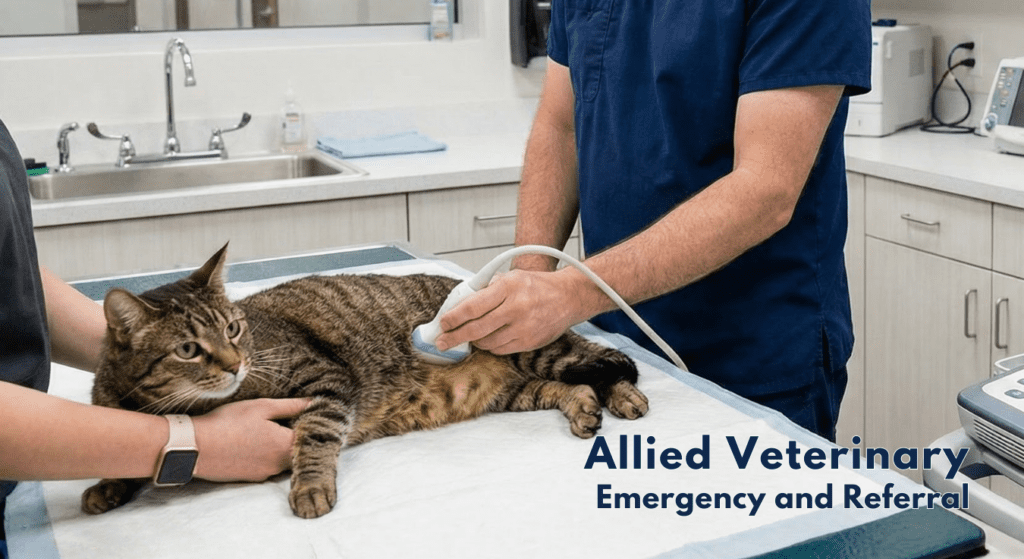
While X-rays excel at showing dense structures, an ultrasound uses high-frequency sound waves to create live, moving images of soft tissues and organs. This technology is completely radiation-free and non-invasive. A small probe is gently moved across your pet’s skin, producing a real-time video feed of their internal organs.
Ultrasound is invaluable for examining the architecture and function of abdominal organs like the liver, kidneys, spleen, and intestines. It allows us to detect tumors, cysts, abscesses, and fluid with remarkable detail. It’s also the primary tool for evaluating the heart (an echocardiogram) and is crucial for guiding procedures like biopsies, ensuring samples are collected safely and accurately from the precise area of concern.
CT Scans: For Detailed, 3D Cross-Sectional Images
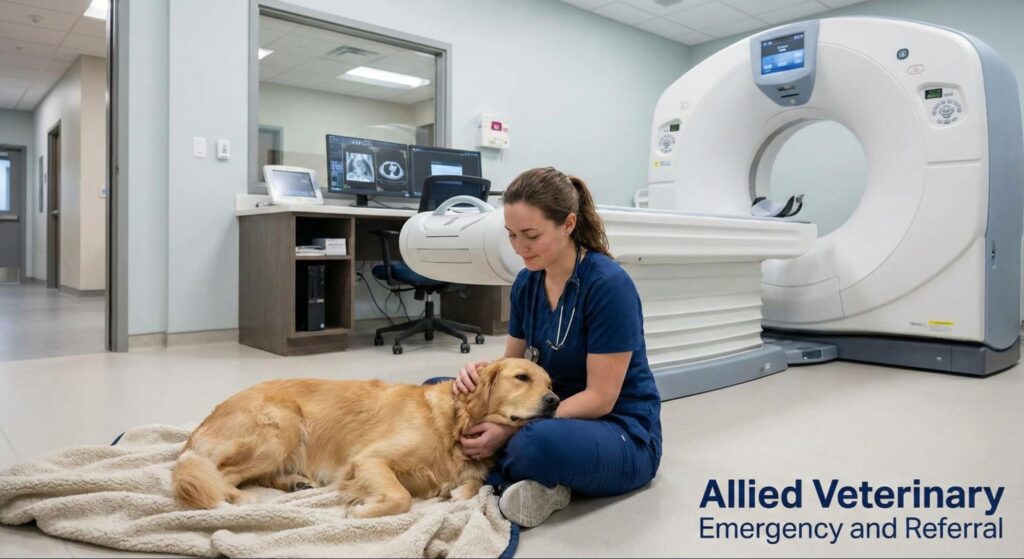
A Computed Tomography (CT) scan is the most advanced imaging modality we offer. It combines a series of X-ray images taken from different angles to produce detailed, cross-sectional “slices” of your pet’s body. A computer then processes these slices to create a comprehensive 3D model. Your pet rests comfortably under brief anesthesia to ensure they remain perfectly still for these highly detailed images.
CT scans provide unparalleled detail, eliminating the overlapping of structures seen in a standard X-ray. This makes them ideal for complex areas like the skull, nasal passages, spine, and complex joints like elbows and shoulders. Our expert surgical team often relies on CT scans for precise surgical planning, especially in oncology cases, as this allows them to see the exact size and location of a tumor and its relationship to surrounding tissues.
Common Conditions We Uncover with Early Imaging
The true value of advanced imaging lies in its ability to detect pet illnesses early, often long before your companion shows significant signs of distress. This early detection dramatically improves the prognosis for a wide range of conditions by allowing for prompt and targeted intervention. When we find problems sooner, treatment is often more effective, less invasive, and more successful.
Our diagnostic tools are critical in identifying many hidden issues. For instance, a pet who has swallowed a toy or a piece of clothing may only show vague signs like lethargy or a poor appetite. An X-ray can quickly pinpoint the foreign object, allowing for its removal before it causes a life-threatening intestinal rupture. Similarly, an ultrasound can reveal subtle changes in organ texture that may indicate early-stage cancer or chronic disease, providing an opportunity for treatment when the condition is most manageable.
Other common conditions we uncover include:
- Internal Bleeding: Following trauma, an ultrasound can quickly identify sources of internal hemorrhage that are invisible from the outside.
- Heart Conditions: An echocardiogram (a specialized ultrasound) can diagnose heart muscle diseases or valve issues before they lead to congestive heart failure.
- Spinal Issues: CT scans and X-rays are essential for diagnosing intervertebral disc disease (IVDD) or spinal injuries that cause pain and mobility problems.
- Complex Fractures: Detailed imaging helps our surgeons plan the precise repair needed for complex bone breaks, ensuring a better recovery.
By leveraging these technologies, we offer more than just a diagnosis but also a clear pathway to recovery. This is a central component of the specialty veterinary care that gives your pet the best possible chance at a long, healthy life.
Your Pet’s Imaging Appointment: A Process Built on Care
We understand that bringing your pet in for an imaging procedure can be a source of anxiety. That’s why we’ve built our entire process around compassion, communication, and your pet’s comfort. From the moment you arrive, our compassionate team is here to support both you and your companion. We are invested in making this experience as smooth and stress-free as possible.
Upon arrival, a technician will gently take your pet to our dedicated imaging suite. For procedures like X-rays and most ultrasounds, your pet will be awake and comforted by our staff throughout the process. We use calming techniques and comfortable positioning to help them relax. If your pet requires a CT scan or a more complex procedure, a safe, short-acting anesthetic will be administered and monitored by our dedicated team to ensure they remain still and comfortable.
Throughout the process, we prioritize clear communication with you. A veterinarian will review the images as soon as they are captured and will meet with you to explain the findings in clear, understandable terms. We’ll discuss what we see, what it means for your pet’s health, and what the recommended next steps are. You will never be left in the dark. Our goal is to empower you with information so we can make the best decisions together for your beloved family member.
24/7 Emergency Diagnostics for Minnesota & Western Wisconsin
Medical crises happen unexpectedly. Immediate access to definitive answers is vital when a pet is in distress. Allied Veterinary Emergency and Referral provides 24/7 emergency services to pet owners across Minnesota and Western Wisconsin. Advanced diagnostic imaging allows us to get those answers day or night.
Pet owners in the Twin Cities can find immediate support at our Brooklyn Park location and our Eden Prairie hospital. Both facilities contain the technology necessary to diagnose urgent and critical conditions quickly. Being a locally owned practice allows us to focus entirely on medical excellence. This independence ensures responsiveness to the specific needs of the community.
Waiting for answers is not an option during an emergency. Our team stands ready to perform necessary diagnostics to identify the problem and start treatment. Please reach out immediately if there are concerns about a pet. We remain available around the clock to provide clarity.
Get the Answers You Need, When You Need Them Most
Internal issues and hidden illnesses often show no external symptoms until they become critical. Advanced imaging allows our team to look below the surface and catch these problems early. This technology provides the detailed view needed to catch hidden ailments before they worsen.
Delaying care until a small issue becomes a major emergency is risky. Talk to our emergency team now to utilize our diagnostic capabilities and get peace of mind.
FAQs
Why is advanced diagnostic imaging important for the early detection of pet illnesses?
Advanced imaging allows our veterinarians to see internal structures like organs, bones, and soft tissues in great detail. This helps us identify problems such as tumors, internal injuries, or blockages long before your pet may show obvious symptoms, leading to faster and more effective treatment.
Do I need a referral for imaging at Allied Veterinary?
While we work closely with referring veterinarians for specialty cases, a referral is not required for our emergency services. If your pet needs immediate care, you can come directly to our hospital, and our team will use all necessary diagnostic tools to help.
Is diagnostic imaging available at both the Brooklyn Park and Eden Prairie locations?
Yes, both our Brooklyn Park and Eden Prairie hospitals are equipped with advanced diagnostic imaging technology to provide comprehensive care. Our team is ready to serve pet owners throughout the Twin Cities metro area 24/7.